
Academies of Louisville Business Students Design Businesses Beyond Profit with Canopy
"Business is not always about just money...it’s about learning your community, working together, finding something new, and doing something interesting for everybody,” concludes Layana Spearman, an Eastern High School business student.
Canopy, a Kentucky-based non-profit, is on a mission to "Make Kentucky First in Good Business" by helping companies prioritize both social impact and financial success. Through their "Business Beyond Profit" curriculum, they provide a specialized instructional unit that teachers can integrate directly into existing business classes.
This "turnkey" package moves students through a comprehensive toolbox—covering everything from governance and internal culture to external impact— that equips them to build businesses with a focus on solving community problems while remaining profitable. As Adam Watson, Director of Education for Canopy, explains, the goal is to give students "the tools to build businesses that succeed by generating not only profit but also purpose."
A Chance Encounter Sparking a District-Wide Movement
The powerful collaboration currently unfolding across the JCPS Academies of Louisville traces back to a single, spontaneous conversation. During Canopy’s 2024 Good Business Summit, Adam Watson met Dr. Reginald McDaniel Jr., who had brought a group of students from The Academy at Shawnee to the event. Dr. McDaniel wanted to expose his students to innovative business ideas, and as he and Watson spoke, they realized a shared vision: the potential to redefine business as a force for good directly within the JCPS curriculum.
For Watson, the heart of this partnership is rooted in his own professional journey as a former attorney and craft brewery owner. He often recounts the collaborative spirit of the brewing industry as a model for this curriculum. "Brewing is the least competitive industry that I've ever seen," Watson explains. "I mean that in the sense that there's a real sense of collaboration even amongst competing breweries. If I was one bag of wheat short, I could get on a Facebook group and immediately have six breweries within a few miles willing to give me that bag just to help me get through the day."
This sense of community—knowing a business exists to contribute something of value rather than just extract money—became the "initial kernel" for the high school unit. Watson recognized that while his curriculum was successful at the collegiate level, it could have an even greater "impact multiplier" if planted earlier. By adapting this graduate-level material for high schoolers, the duo created a pathway for students to build their own professional "operating system" based on empathy and community impact. This relationship has now grown into a district-wide initiative that bridges the gap between the high school business curriculum and real-world issues.
The Toolbox in Action: Solving Real-World Problems
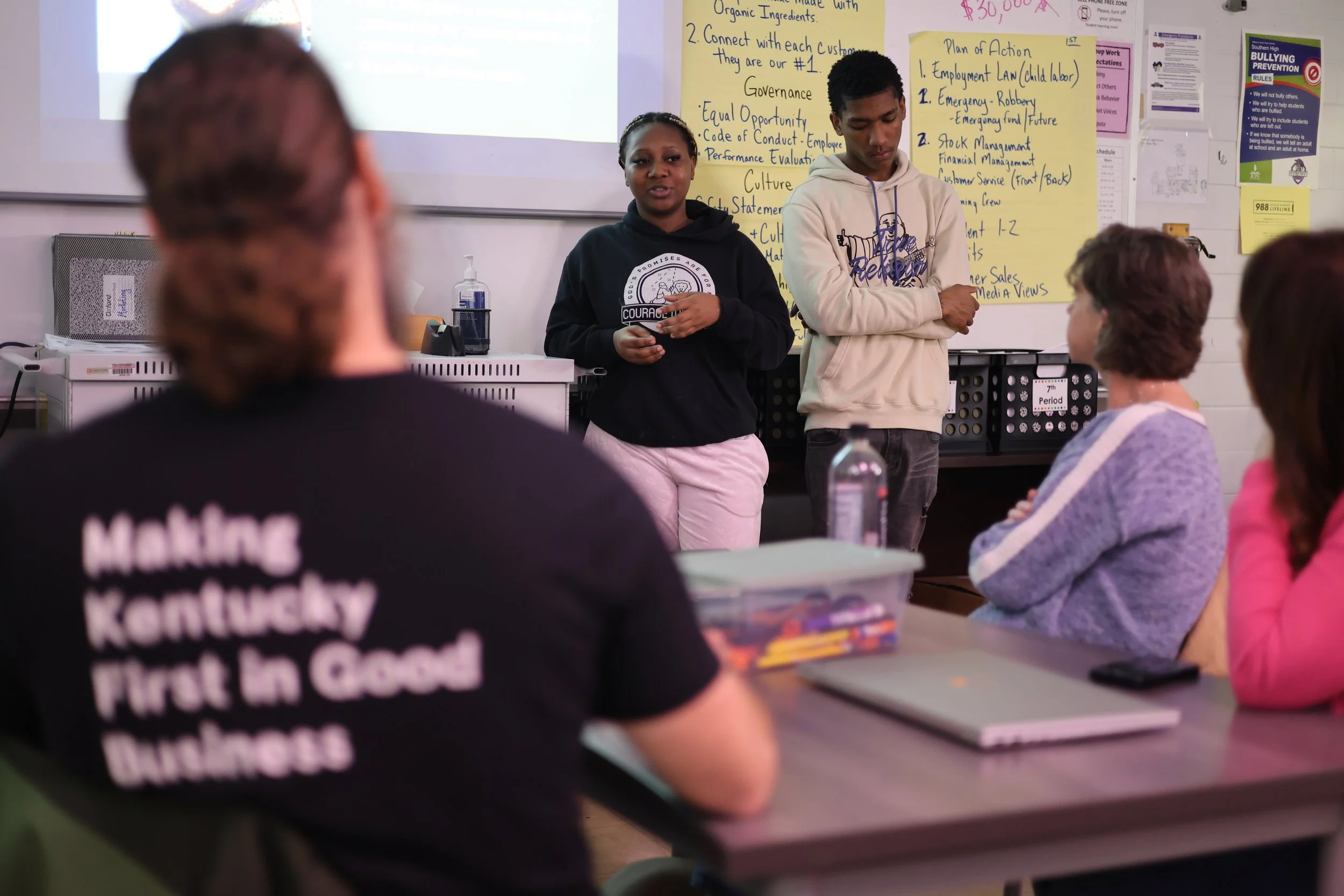
The "Business Beyond Profit" curriculum moves beyond abstract theory, challenging students to look at their own neighborhoods and identify acute social or economic problems. In Ben Matheis' project at Eastern High School, he addressed the lack of resources in food deserts by designing a baby store that provides high-quality food and clothing at affordable prices. His model even included a creative "use and return" system to help families manage the costs of rapidly growing children.
Other students used the curriculum to tackle tech and service gaps. Tyson Fullilove, a Southern High School student, developed a tech-driven contact lens company to help college students record lectures and protect their academic integrity. He noted that business is not just about sales but about community and connecting with employees.
Other groups look to solve issues in their school’s backyard. At Southern, Jeremiah Whitehead pitched a pizza restaurant designed to reduce industrial food waste, using the business's brand identity to support local charities. Eastern’s Layana Spearman brought a unique focus to the unit with a community dog park themed around breast cancer awareness.
A Partnership of Mutual Success
This collaboration is a textbook example of a mutually beneficial partnership. For the Academies of Louisville, Canopy provides a high-level curriculum that helps meet students where they are and takes them where they need to be, fostering technical skills, grit, and communication. It demystifies the transition to the professional world and strengthens the local educational ecosystem.
For Canopy, the partnership achieves its core mission to scale "good business" practices across the state. By engaging Generation Z students—who Watson notes are "far more engaged, far more interested, and far more capable" than stereotypes suggest—Canopy is nurturing a workforce that values transparency, inclusion, and social responsibility. The success of the pilot has already led to the curriculum being taught at Shawnee, Eastern, Fern Creek, and Southern, with plans to expand to Iroquois and Ballard before the end of the school year.
Ultimately, the goal is to prepare students to change the world through their careers. As Watson sees it, the greatest reward is "watching them really onboard the lessons and really take that fire into their lives and leave the class ready to go do this thing in the world that at the beginning didn't even seem like a possibility."