
JTown’s Pahel Patel Discovers Her Medical Future in the Lab
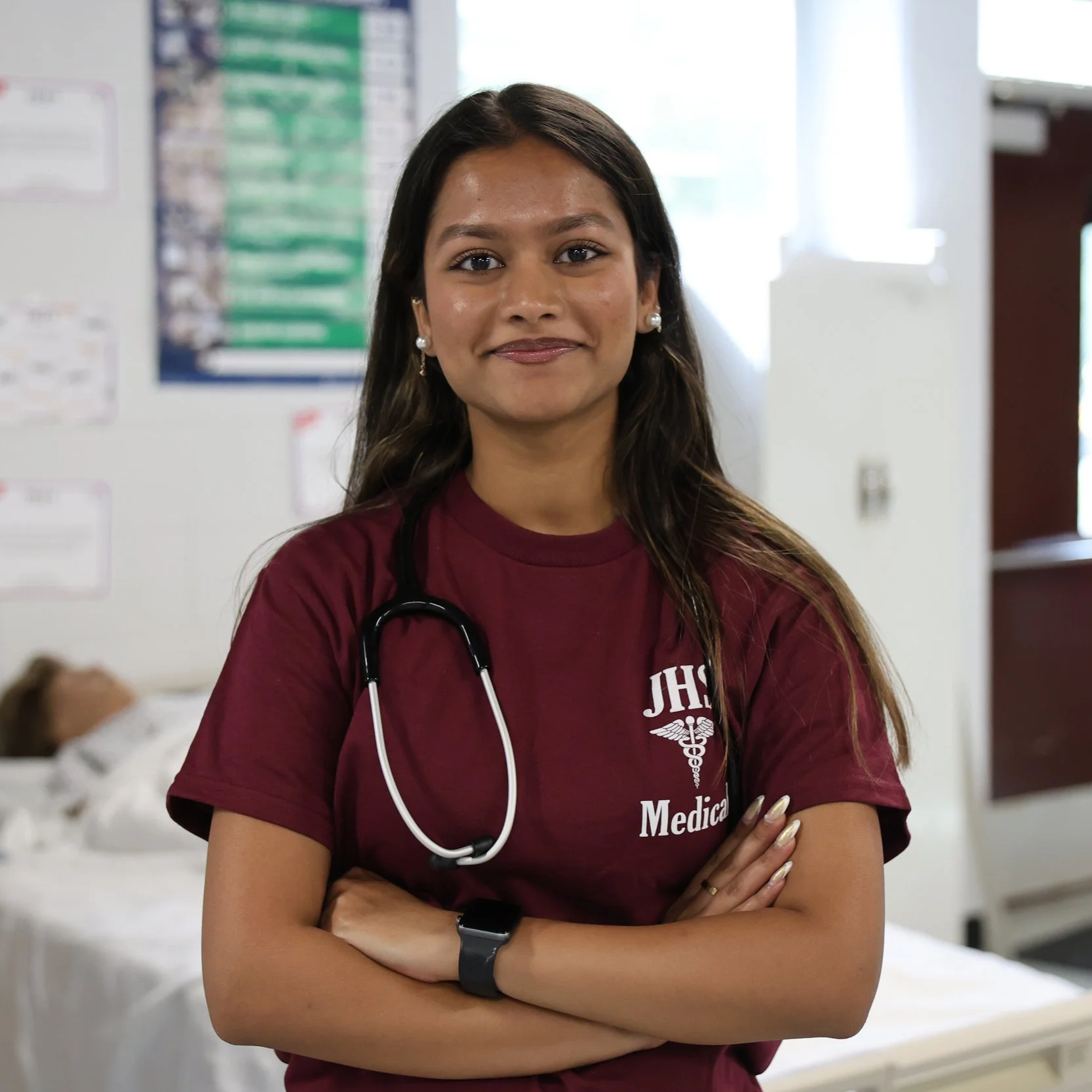
"My motive was to find out a drug that could potentially attack brain cancer cells and kill them forever."
For Pahel Patel, a senior in the Health Science Academy at Jeffersontown High School, these final months before graduation are not about coasting. Instead, they are about maximizing a hands-on learning experience that is directly bridging the gap between classroom theory and her future professional goals. Through this academy curriculum, Pahel has gained the technical and analytical tools necessary to turn an academic requirement into the launchpad for a highly successful career in medicine.
Pahel found her specific passion for neurological research through an intensive summer internship at the University of Louisville Brown Cancer Center, where she spent months working alongside professionals to solve a major challenge in modern medicine: treating aggressive brain cancer.
To deliver the treatment effectively, Pahel developed an innovative delivery method using natural compounds and milk-derived exosomes to bypass the body's natural defense systems.
"Exosomes worked as a nanoscale vehicle to travel through the blood-brain barrier," Pahel points out. "This is your brain, and there is a barrier over it, which protects the brain from anything to enter it. No drugs, no medicine, nothing can enter the brain. So I had to figure out a way to get my drug to pass through this, so exosomes worked perfectly. Later in my research, we tried it on rats, and it had a very high compatibility to kill the brain cancer cells."
Learning to Navigate Open-Ended Challenges
The ability to secure and manage such a complex, graduate-level research assignment comes from the unique culture of Pahel's high school pathway, where instructors intentionally push students to pursue advanced opportunities. Pahel connected with the competitive research program after her biology teacher encouraged her to apply.
"It was this program that my biology teacher told me about, and she was like, 'Hey, you should definitely sign up,'" Pahel notes. "I signed up for it. I wrote an essay. I answered multiple questions about myself, what I studied throughout my high school year, and everything that I learned, and I got accepted."
That foundational classroom preparation has provided Pahel with an environment that mimics the clinical world, giving her a massive head start on the interpersonal and practical demands of the healthcare industry.
"CTE training prepares me for an everyday work environment of how it would be like in the future," Pahel says. "It prepares me on how to talk to new people, how to diagnose them, and how I can make them feel comfortable with me. They give us many hands-on experiences."
By combining these real-world communication skills with technical clinical practice, Pahel has built a portfolio of high-demand credentials before even receiving her high school diploma. She is already CPR certified and is on track to earn her Patient Care Technician (PCT) certification, giving her a major competitive advantage over traditional students.
"By having our certifications, it already had me ahead of other peers," Pahel explains. "For example, PCT certification, not many students have that. By getting this, I will be able to work as a PCT during summer if I choose to, and that will definitely set off my college resume-wise. When I am applying for jobs or anything during my college years, it will definitely make me stand out from other students."
Prepared for the Next Chapter
By balancing her hands-on pathway experiences with rigorous laboratory research and regular volunteer work on the children's unit at Baptist Hospital, Pahel feels completely ready for the demanding academic environment of higher education.
"They teach you many things about how college works, how real life is, how the hospital environment is," Pahel says.
Her dedication has paved a direct path to the University of Kentucky, where she will major in neuroscience this fall. Her time spent navigating complex biological systems in high school has left her excited to immerse herself in advanced science courses and connect with a wider academic community.
"I am going to University of Kentucky and majoring in neuroscience," Pahel shares. "I hope it is a great experience. Definitely would love to meet new people."
Looking Toward Global and Clinical Impacts
When Pahel thinks about her long-term career, she isn't just looking at standard clinical roles—she is looking at how advanced surgical and neurological procedures can save the most vulnerable patient populations. She views the medical field as a space where she can blend her love for complex science with a deep passion for patient care.
"Career-wise, I do want to be a fetal surgeon. That has been my plan for many years," Pahel declares. "Fetal surgeons basically operate on babies while they are still inside the womb. But the brain is also very intriguing to me, so I will just see how it goes after college."
Ultimately, Pahel is engineering a future where her work will leave a profound impact on the medical community. By mastering the science of patient care and cellular research today, she is setting the stage to protect and heal the lives of tomorrow.