
Bringing the Horizon to the Hallway: How Seneca High School Innovates Teenage Career Navigation
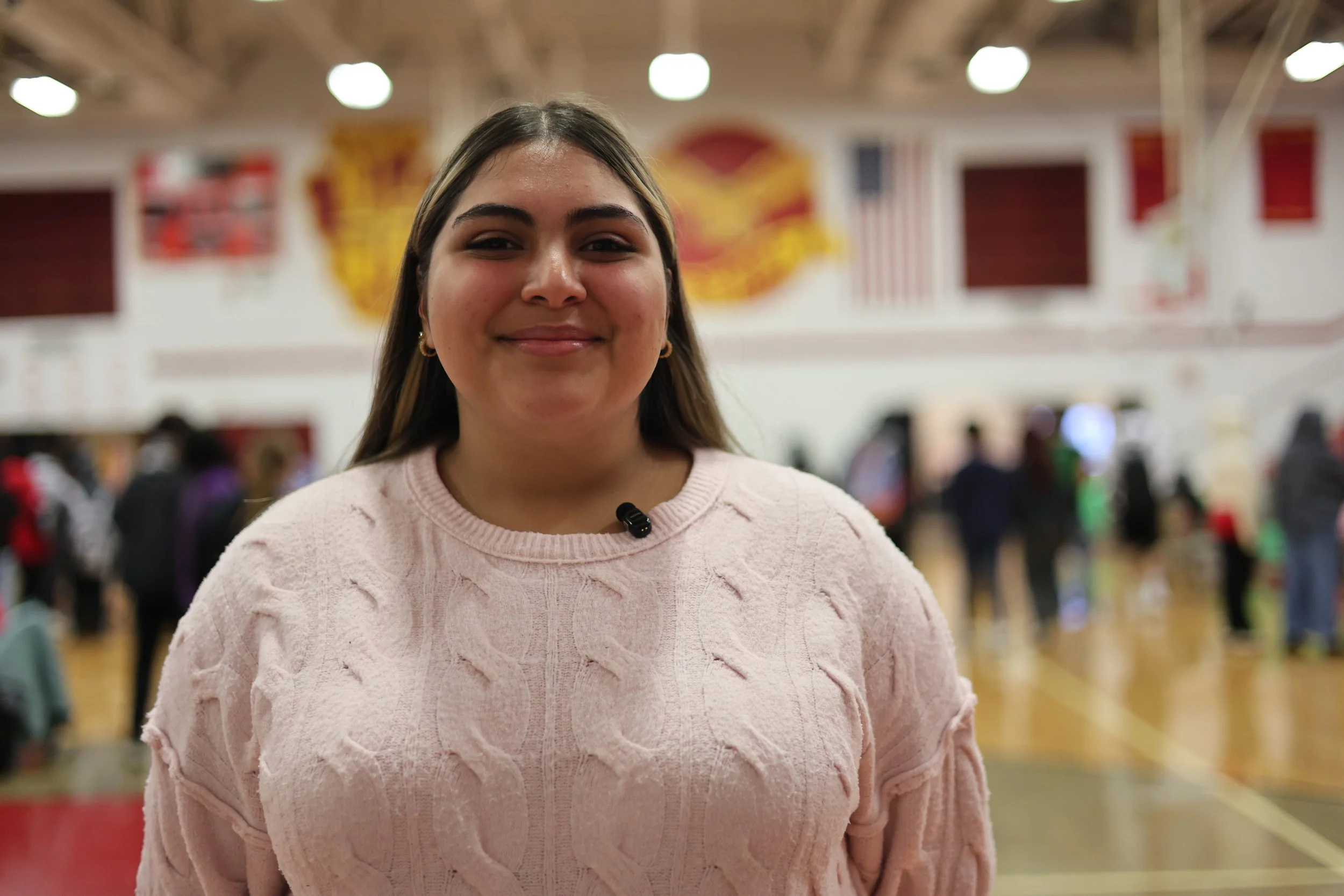
Keishla
When Keishla Aguilar walked through the doors of Seneca High School as a freshman, she was certain her future lay in a quiet corporate office. She loved math and numbers, and her mind was set on a practical, predictable default: accounting. It was a logical choice for a student who liked structure. But career-connected learning hits its highest gear when professional exposure collides directly with a student's core personal values.
Over the course of a single academic year, Keishla’s trajectory completely rewrote itself. It didn't happen because of a single lightbulb moment but through a deliberate, ten-part freshman exploration pipeline engineered by Seneca’s Academies. By the arrival of the spring Reveal Ceremony on May 8, 2026, Keishla wasn't holding an accounting certificate. Instead, she found her official placement in Health Science—setting her on a fiercely motivated path to become a future Labor and Delivery Nurse Practitioner.
High school redesign is often treated as an exercise in macro-data and scheduling blocks. But true workforce readiness is an emotional, psychological, and cognitive evolution. Seneca High School has operationalized the national research of Hans Meeder, author of Preparing Tomorrow's Workforce, to transform freshman year into a living laboratory. Meeder’s framework argues that sustainable economic development requires teaching teenagers a specific bundle of "Career Navigation Skills"—the combination of self-knowledge, deep workplace literacy, and the decision-making fortitude required to actively design their own futures.
To explore the depth of this system, we tracked four Seneca freshmen—Keishla Aguilar, Hawa Osman, RJ Sean Abaya, and Nathaniel Mack—across their entire first year of high school. Their real-time transformations reveal that career readiness isn't about forcing a fourteen-year-old to rigidly predict the rest of their life; it is about providing a year-long safety net of immersive exposure that gives young people the rare grace to test assumptions, experience productive friction, and confidently pivot until their career path perfectly matches who they are.
The System: Seneca's 10-Part Pipeline
In traditional high school models, career selection is often treated as a singular event: a checklist or a standard aptitude test dropped onto a student’s desk. In contrast, Hans Meeder’s framework treats career readiness as a developmental muscle that requires progressive conditioning.
True career navigation requires a student to move sequentially through three critical psychological boundaries: Awareness (demolishing narrow assumptions and expanding horizons), Exploration (testing those assumptions against real-world data and personal boundaries), and Application (actively claiming a professional identity).
Seneca systematically operationalizes this developmental progression, engineering a ten-part freshman pipeline that ensures immersive, deep exploration completely precedes any high-stakes final commitment:
Phase I: Career Awareness (Sept–Dec)
Pipeline Stages: Family Info Sessions, Upperclassman Classroom Visits, The Career Showcase.
Strategic Purpose: Demolishing narrow expectations and exposing students to the scale of the regional economy.
Phase II: Career Exploration (Nov–Jan)
Pipeline Stages: Career Research Project, Small-Group Career Panels, Classroom Pathway Shadowing, Cafeteria Career Convos, Virtual Reality Experience.
Strategic Purpose: Active investigation. Moving from observing to participating in small-group professional dialogues and stress-tests.
Phase III: Career Application (March–May)
Pipeline Stages: Formal Academy Application, The Pathway Reveal Ceremony.
Strategic Purpose: Explicit commitment. Students claim their professional identity and begin targeted CTE paths.
Phase I: Career Awareness and the "Productive Chaos" of the Gym Floor
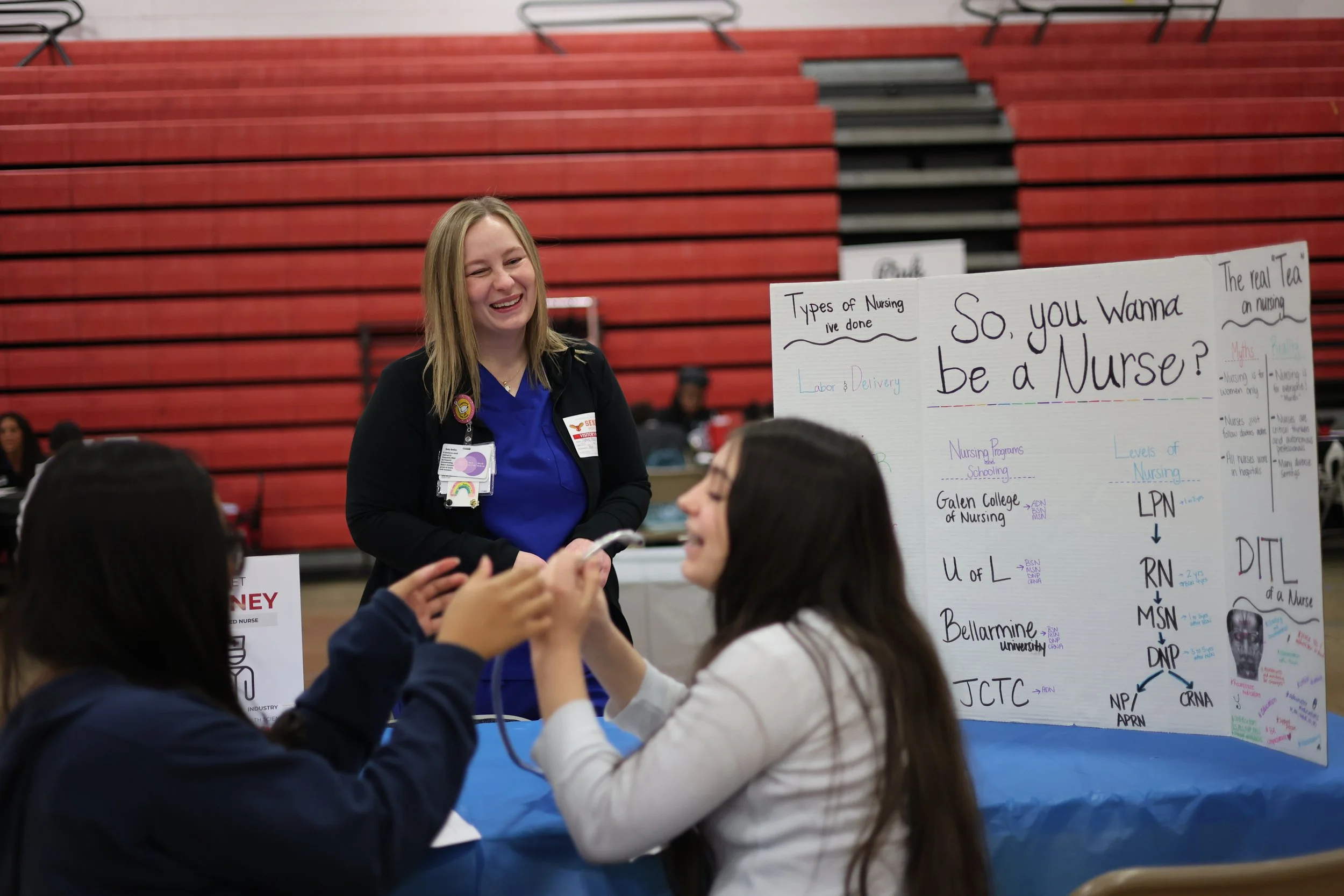
Seneca Career Showcase
According to Meeder’s framework, the initial stage of career navigation requires a deliberate destabilization of a student’s narrow worldview. Teenagers typically arrive at high school predicting their futures based entirely on what they see on television or what they observe at their own dinner tables. The goal of Phase I is to shatter those low or limited expectations by exposing them to the staggering scale of the regional economy.
At Seneca, this phase begins with the start of high school, reaching an intensity during the second week of November with the annual Career Showcase. The school transforms its gymnasium into a color-coded sea of corporate displays, post-secondary institutions, and regional employers. Armed with graphic organizers, freshmen are challenged to cross sector lines, gather professional signatures, and step directly out of their comfort zones.
The immediate psychological result of this massive exposure is not instant clarity. It is productive confusion—and that is exactly where true navigation begins.
"It's more complicated, I would say," Hawa Osman admitted during her first check-in immediately following the November event. "I came in with a mindset of saying, 'Okay, I want to do pre-nursing.' Then I saw all the different careers and pathways and I thought, 'Wait, I like all of them.' I'm stuck in between everything."
Nathaniel Mack experienced the same structural disorientation. He had entered freshman year defending a Business path simply because it felt like a safe, logical default. "It's more complicated because more decisions opened up," Nathaniel noted in November. "I didn't realize how many pathways were actually here before the Showcase."
Even students who arrived with seemingly unshakeable conviction found their early assumptions thoroughly disrupted. RJ Sean Abaya had planned on entering law since middle school, inspired by his uncle’s legal practice in the Philippines. Yet, standing on the gym floor, a charismatic representative from Boyd CAT operating heavy machinery caused an immediate internal calculation. "The guy who made the heavy machinery made it really hard for me to decide," RJ smiled. "He made being a mechanic sound fun. He gets to create things and work with heavy machinery. It made things complicated."
In Meeder's paradigm, this complication is a victory. Before a young person can navigate a map, they have to be humbled by how massive the territory actually is.
THE GRADUATION ADVANTAGE
The Academy Value Chain:
Developed Career Navigation Skills → Saved College Tuition → Accelerated Career Placement → Unshakable Personal Purpose
Phase II: Career Exploration and the Intimacy of the Human Element
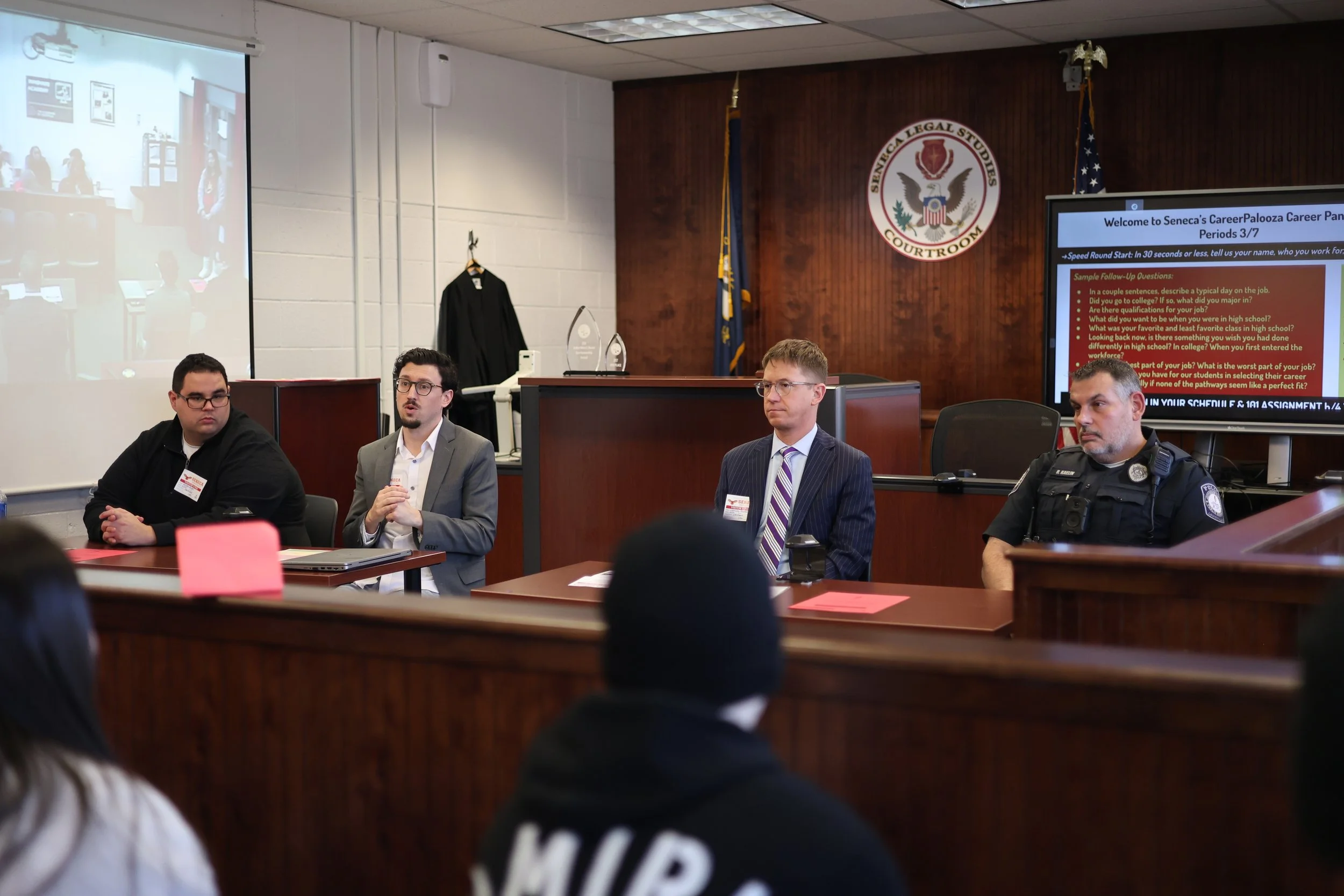
Seneca Career Panels
Once a student's horizons are expanded, Meeder’s framework dictates a transition from macro-awareness to micro-exploration. This phase requires students to stress-test their initial impressions against granular, real-world data and personal identity alignment.
Seneca achieves this deep-dive exploration through two sequential milestones: the December Career Panels and the January Classroom Shadow Visits.
The first shift occurred the week before the holiday break in December, when Seneca intentionally shrank the world. The school moved away from the loud, stadium-style environment of the gym and transitioned into intimate Career Panels tucked inside quiet classrooms. Groups of fewer than twenty freshmen sat face-to-face with small panels of three to five working professionals for fifteen-minute, ambassador-led dialogues.Rather than being assigned at random, students actively drove the exploration, choosing their top three career panels from the pathways they were most interested in navigating.
This intimacy is where the emotional depth of the selection process crystallized. The freshmen stopped looking at abstract job titles and began evaluating fields through the lens of human vulnerability.
For Keishla Aguilar, this exploratory phase completely rewrote her future. She had entered freshman year planning on an accounting path because she was "really into math and numbers" and imagined her life inside a predictable office cubicle. But during her December check-in, fresh off listening to an education representative discuss a paralyzing fear of public speaking, and a child protection attorney detail a heartbreaking 20-year case, Keishla's internal compass completely pivoted from ledger data to human advocacy:
"I've always been a person you could call a feminist," Keishla explained, connecting her core values directly to her sudden healthcare pivot. "That’s why if I went into law, I’d be a women's rights lawyer. But listening to the medical panel, I feel it is just so mesmerizing how the woman's reproductive system works. Giving birth to a child is one of the most vulnerable states in life, and I want to be there to help every woman possible through every complication. The industry panels made my choice clearer because they gave me perspectives from actual people."
KEISHLA'S EXPLORATORY SHIFT
The Awareness Baseline (November): Math, Numbers, & Safe Office Spaces
The Exploratory Encounter (December): Vulnerable Advocacy & Deep Personal Values
The Navigational Target (May): Labor & Delivery Nurse Practitioner
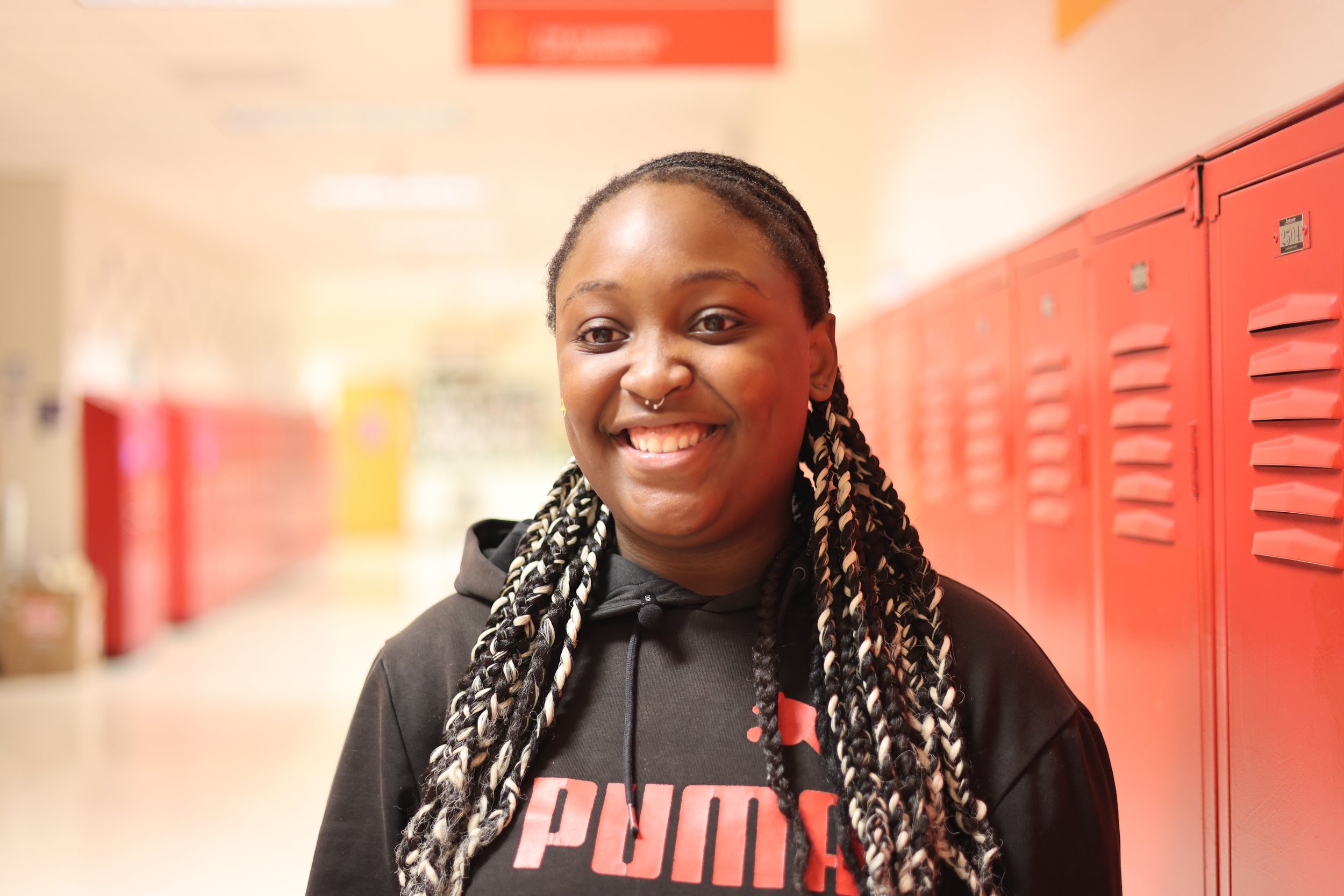
Hawa
In an adjacent classroom panel, Hawa was using that same intimate access to filter her medical ambitions around her own rigid personal boundary: she desperately wanted to help patients, but she could not stand the sight of blood.
"I talked to somebody from the UofL Hospital, and she told me about all the opportunities in nursing," Hawa recounted. "I learned that nursing isn't just one thing. If you don't like blood, you can be the one behind the computer typing instead. After hearing that there is a job behind the computer where I don't have to deal with blood, I thought, 'Oh, that's something I would look into.'"
For RJ, the December panels served as an essential point of validation. While heavy machinery had tempted him in November, sitting inches from a practicing criminal defense attorney anchored his path. "The attorney made being a lawyer sound fun and interesting, and I was really into it," RJ said. "I wasn't really interested in health or whatever my parents wanted me to do. That sealed the deal for me."
The Power of the January Pivot
The true crucible of Meeder’s exploration phase, however, lies in trial and error—and learning what you don't want to do is just as triumphant as discovering what you love. This was the exact lesson engineered for Nathaniel Mack during the January Classroom Shadow Visits.
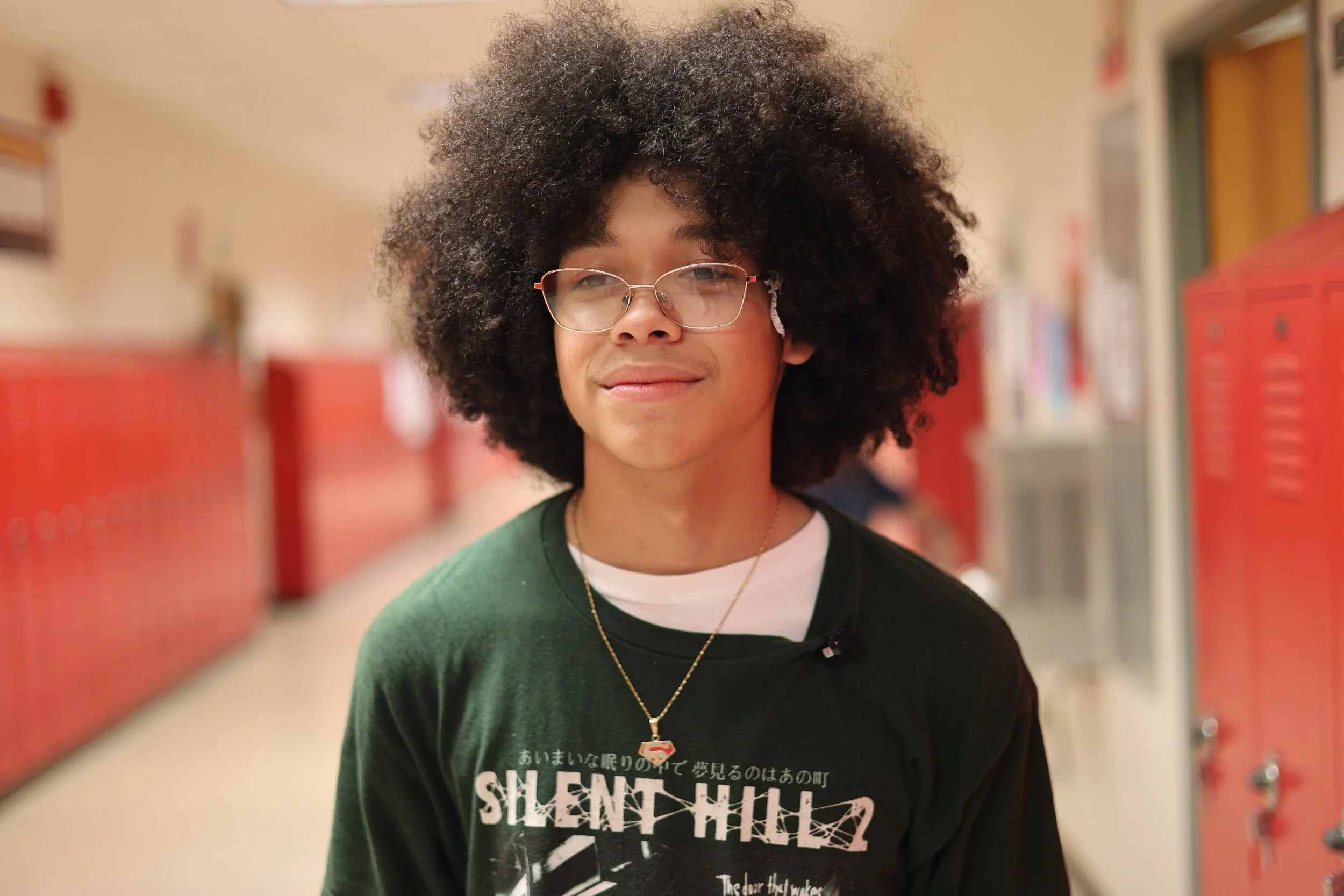
Nathaniel
For months, Nathaniel had intellectually defended a Business track because it felt practical. But Seneca’s pipeline requires students to physically stand inside the spaces they choose. When Nathaniel sat in the actual Business classroom for his shadow rotation, his emotional reality collided with his practical plan.
"Business just didn't seem like it was for me," Nathaniel reflected with a striking amount of navigational maturity. "When I visited that pathway in the classrooms, it just didn't seem as fun as I thought it would be. It seemed very bland compared to the rest of the classes, and I didn't want to do anything that I wouldn't have fun in."
Because the Freshman Academy is designed as an active sandbox rather than a rigid tracking system, Nathaniel had the structural autonomy to pivot. He looked back at his notes from the Agriculture panel, remembered how deeply the environmental reps cared about the world, and redirected his application toward Ag Animals. The system gave him the opportunity to fail a personal hypothesis early, saving him years of potential misalignment down the road.
Phase III: Career Application and the Certainty of the Reveal
RJ
The final tier of Meeder’s framework is Application—the transition from exploring possibilities to actively claiming an identity and committing to a structured course of action.
At Seneca, this phase culminates on May 8, 2026, at the Career Pathway Reveal Ceremony. After surviving a nine-month gauntlet of awareness and exploration, the initial fog of freshman year cleared into absolute focus. Freshmen gathered in the gym to open envelopes revealing their official pathway assignments, marked by name and distinct academy colors.
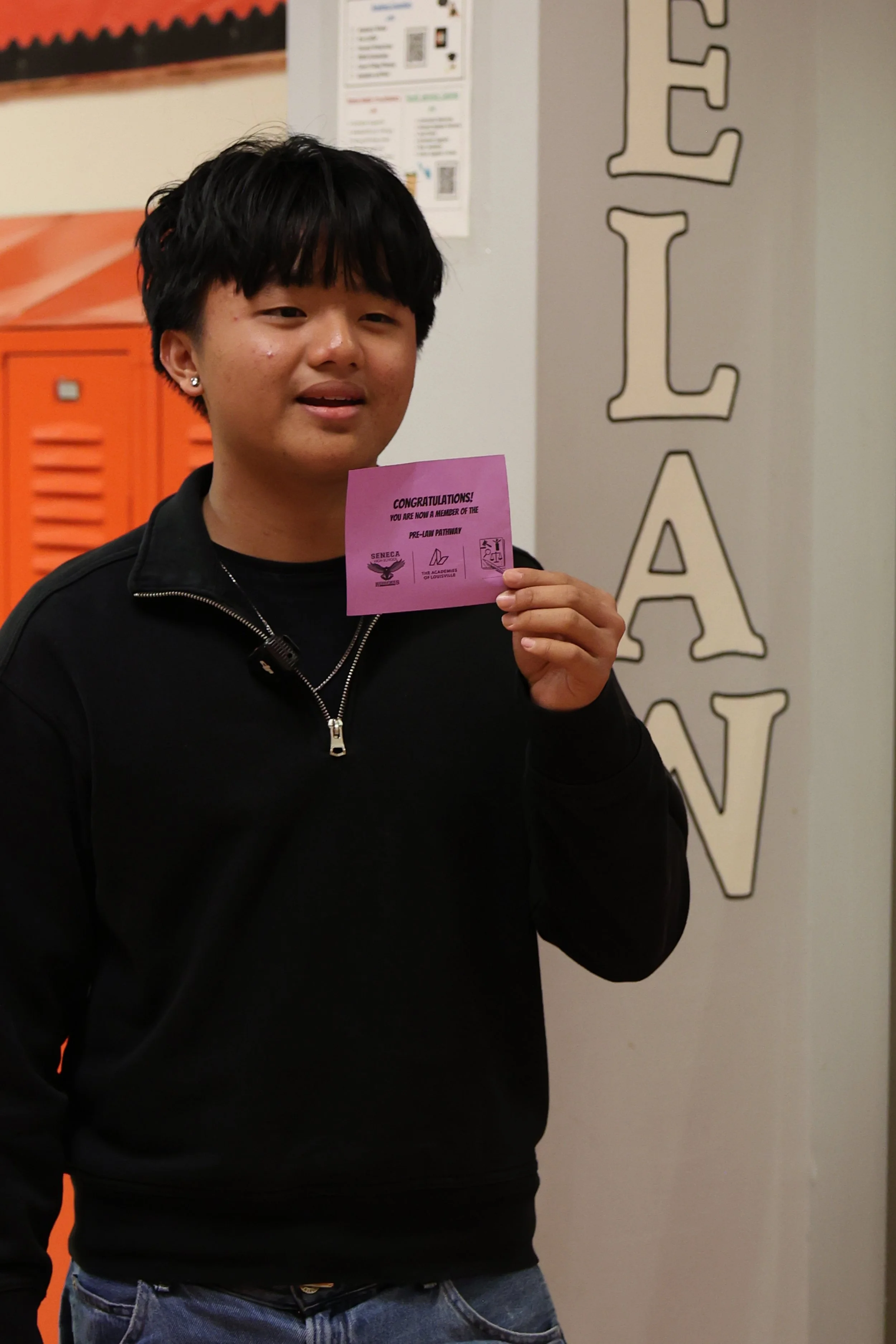
Hawa Osman officially emerged in Health Science, proudly announcing her targeted future path: "As of today, I want to be an ultrasound tech." RJ Sean Abaya officially stepped into Pre-Law, holding up his placement certificate with a clear, mentor-backed blueprint for execution: "As of today, I will be a lawyer."
Nathaniel Mack, completely reversing his initial default track, celebrated his official placement in Agriculture Animals, focused on environmental research. And Keishla Aguilar, though unable to attend the physical ceremony, achieved the exact victory she had spent the year engineering—a formal placement in Health Science with a fierce, specific conviction: "As of today... I want to be a labor and delivery nurse practitioner."
The Mapping of a Mindset: Four Freshman Journeys
Over nine months, these four freshmen transformed wide-eyed baseline awareness into a deeply internalized professional trajectory:
📂 Student Profile: Keishla Aguilar
Phase I: Career Awareness (November Baseline)
Career Pathway: Business & Enterprise / Accounting Focus
Navigational Mindset: > "I love math and numbers, but today made me more open-minded."
Phase II: Deep Exploration (Winter Rotation)
Career Pathway: Health Science Focus
Navigational Mindset: > "It is mesmerizing how the reproductive system works. I want to protect women."
Phase III: Targeted Application (May 8, 2026 Engagement)
Career Pathway: Health Science
Strategic Target:✨ Official Path: Labor & Delivery Nurse Practitioner
📂 Student Profile: Hawa Osman
Phase I: Career Awareness (November Baseline)
Career Pathway: Health Science / Pre-Nursing Track
Navigational Mindset: > "I'm stuck in between everything. The Showcase made it more complicated."
Phase II: Deep Exploration (Winter Rotation)
Career Pathway: Health Science / Pre-Law Strategic Split
Navigational Mindset: > "I'm leaning toward law because I want to help people but I hate blood."
Phase III: Targeted Application (May 8, 2026 Engagement)
Career Pathway: Health Science
Strategic Target:✨ Official Path: Future Ultrasound Technician
📂 Student Profile: RJ Sean Abaya
Phase I: Career Awareness (November Baseline)
Career Pathway: Pre-Law / Architecture & Hands-on Mechanic Split
Navigational Mindset: > "I want to be a lawyer like my uncle, but the CAT mechanic made it hard."
Phase II: Deep Exploration (Winter Rotation)
Career Pathway: Pre-Law Confirmation Phase
Navigational Mindset: > "Sitting with the defense attorney sealed the deal for me. I'm choosing law."
Phase III: Targeted Application (May 8, 2026 Engagement)
Career Pathway: Pre-Law
Strategic Target:✨ Official Path: Future Defense Attorney
📂 Student Profile: Nathaniel Mack
Phase I: Career Awareness (November Baseline)
Career Pathway: Business Management Track
Navigational Mindset: > "I want the freedom to make money for myself."
Phase II: Deep Exploration (Winter Rotation)
Career Pathway: Environmental Agriculture Shift
Navigational Mindset: > "Business felt very bland in the classroom. I want to help the environment."
Phase III: Targeted Application (May 8, 2026 Engagement)
Career Pathway: Environmental Agriculture
Strategic Target:✨ Official Path: Ag Animal Research
This is the ultimate Return on Investment for the Academies of Louisville. When these four students step across the graduation stage three years from now, they will not enter the post-secondary landscape as passive observers guessing at their majors or stumbling blindly into careers they will eventually abandon.
By investing an entire academic year into the architecture of career navigation, Seneca High School has given its freshmen far more than an event itinerary. They have given them a lifelong cognitive skill set. These students spent a year looking into the mirror of the local economy, separating structural distractions from their true individual values, and testing their limits. They looked past the horizon, they saw their futures, and now, they are stepping forward to build them.