
Where Futures Take Shape: Reimagining the High School Experience in Louisville
When public education shifts from abstract textbook learning to active, community-wide collaboration, the entire trajectory of a city changes. The Academies of Louisville model continues to turn local schools into active economic engines, equipping tens of thousands of students with the precision skills required to thrive in a rapidly changing modern workforce. By breaking down the walls between the classroom and the local economy, this structural framework has evolved past a localized high school program to establish itself as a premier national blueprint for career-focused education.
By The Numbers: Peak Performance and Deepening Impact
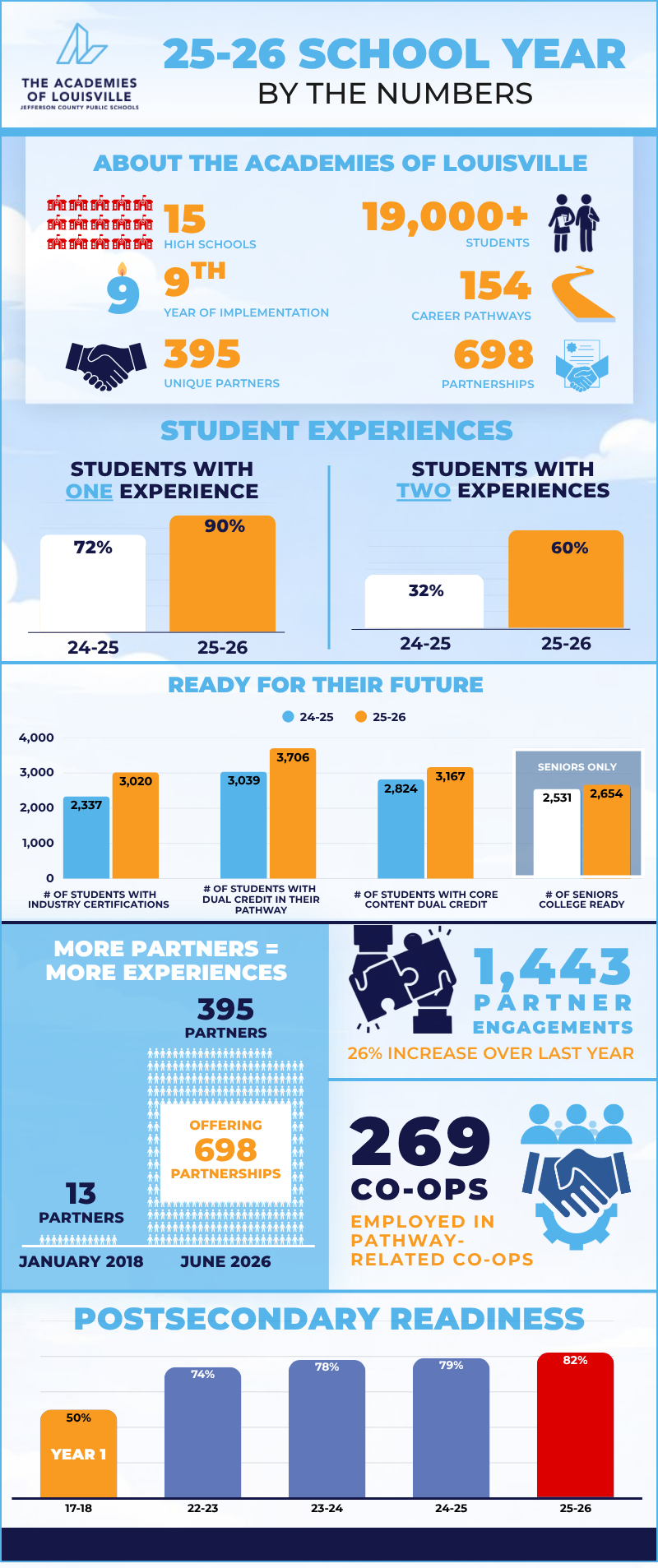
The data from this past school year explicitly demonstrates that when classroom instruction connects directly to a student's future career aspirations, academic outcomes soar.
Record Postsecondary Readiness: Our Postsecondary Readiness (PSR) rate—a metric defined by the Kentucky Department of Education that tracks industry certifications, college credits, benchmarks on college entrance exams, and work experience to evaluate how prepared students are for the next level— reached an all-time high of 82% this year, crossing the critical 80% threshold for the first time. This represents a 3% increase over last year and an astonishing 30% increase since we launched the Academies model in 2017.
The Power of Multiple Experiences: The depth of student engagement continues to prove vital. Students who participated in two or more career-connected learning opportunities achieved a 9% higher PSR rate than their peers.
Explosive Volume Growth: Total student engagement opportunities increased by 26% over last year, delivering more than 1,400 career-connected experiences across the district.
Unprecedented Student Reach: 90% of students participated in at least one career-connected experience this year—up from 72% last year—extending real-world exposure to approximately 3,400 additional students.
Doubling the Depth: 60% of students participated in two or more real-world experiences, nearly doubling last year's rate of 32%.
Surging Professional Credentials: Students earned 3,272 industry certifications this year, a 16% increase over the 2,824 certifications earned last year.
National Quality Standards: Ten of our Academies have now achieved the prestigious National Career Academy Coalition (NCAC) Model Academy status, with Fern Creek High School and Jeffersontown High School earning their new national distinctions this year.
A Thriving Partner Network: Our active business and community network grew to 395 unique partners this year—a 39% increase over the past two years and nearly 30 times the number of partners that helped us launch.
From Concept to Ecosystem: The History of the Academies
To fully appreciate these achievements, one must understand the intentional, decade-long evolution that brought us here. The story of the Academies of Louisville is not about a quick programmatic fix; it is about completely upending the status quo of traditional secondary education.
The seed was planted when a delegation of JCPS educators and local business leaders traveled to Tennessee to study the highly successful Academies of Nashville. Recognizing the transformative potential of restructuring massive, traditional high schools into smaller, thematic learning communities, the group brought the vision back to Jefferson County.
In 2014, Louisville was formally designated as a Ford Next Generation Learning (NGL) community, initiating a rigorous planning phase to align local school structures with regional workforce needs. In the fall of 2017, the Academies of Louisville officially launched. The model began with 11 high schools and 13 core business partners, introducing a framework where students choose a specialized career pathway—ranging from engineering and aviation to healthcare and business—at the end of their freshman year.
Over the last nine years, this prototype has matured into a comprehensive city-wide ecosystem. Today, the Academies model encompasses 15 high schools, supports nearly 400 business partners, and directly impacts more than 19,000 students. By embedding local employers directly into the academic framework through advisory boards, mock interviews, resume workshops, and internships, the district has successfully transformed schools from isolated classrooms into talent pipelines for the modern economy. As Ford NGL Executive Director Cheryl Carrier notes, the goal is straightforward: instead of buying or borrowing talent, this model ensures that the community builds its own employees.
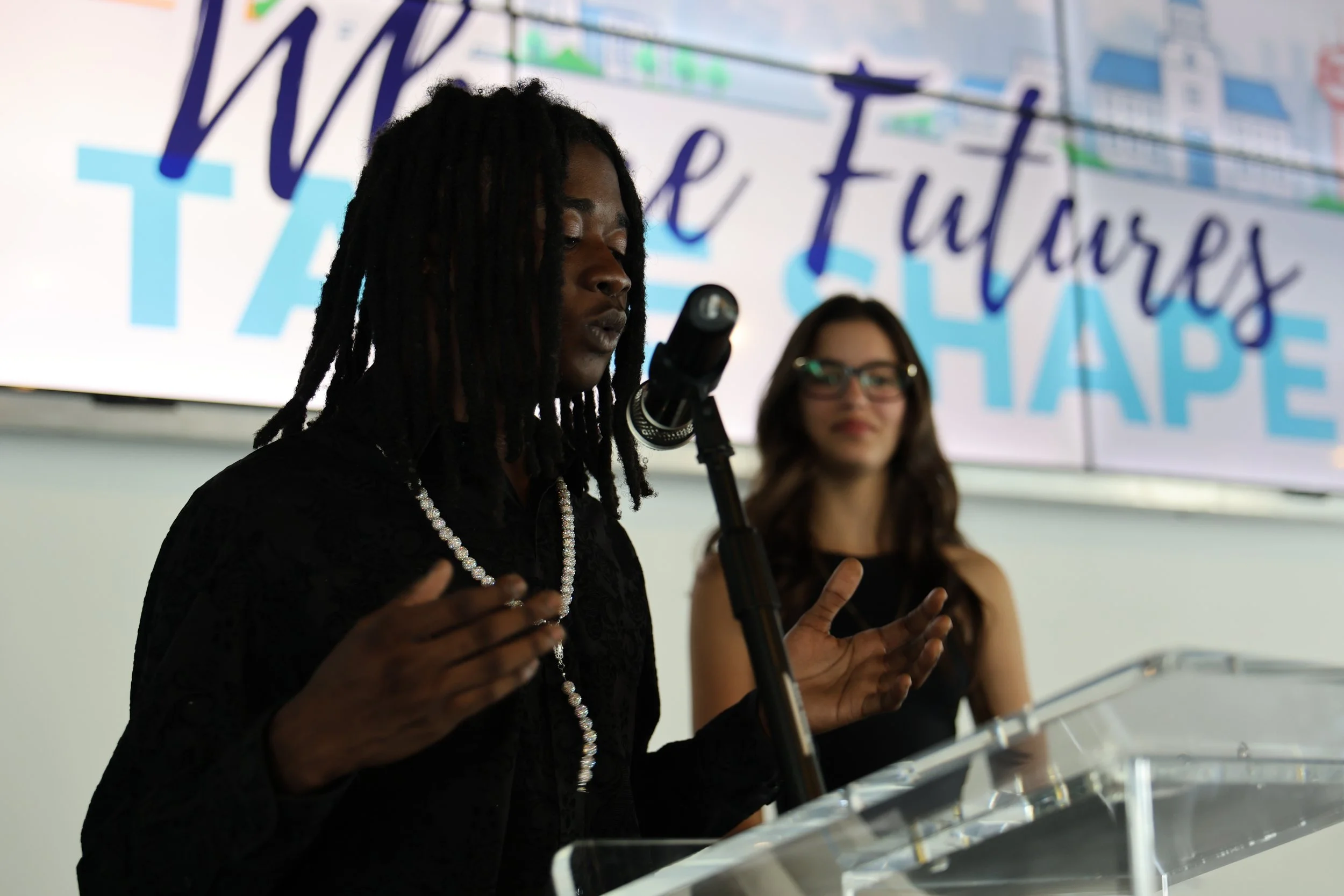
Student Voices: The Real-World Proof
The true validation of this history is found in the young professionals walking across our graduation stages. At this year's celebration, student emcees Aliete Yanes Medina and Jerrel Thompson shared what this educational framework looks like in practice:
Jerrel Thompson (The Academy at Shawnee, Class of 2026): Jerrel entered Shawnee in 2022 completely unsure of his path. Through the Business and Entrepreneurship pathway, he gained hands-on experience with Louisville's leading organizations, conquered a severe fear of public speaking, and led his team to victory in the Class Act Marketing challenge. This fall, Jerrel is bound for Kentucky State University to study law, with the long-term ambition of owning his own firm and generating opportunities for others from similar backgrounds.
Aliete Yanes Medina (Fern Creek High School, Class of 2026): Arriving in Louisville from Cuba just before high school, Aliete spoke very little English and spent her freshman year relying on Google Translate to understand her classes. Supported by a dense network of educators, she remained in the business pathway, ultimately presenting a 30-page corporate proposal to local business partners entirely without translation software. She graduated last month as class valedictorian, earning over $1.7 million in merit-based scholarships. After completing a research internship at the UofL Brown Cancer Center and winning iGEM—the world's premier biosynthesis competition—against collegiate teams, she is heading to Davidson College to double major in biochemistry and political science.
Looking to the Future: Systemic and Physical Investment
As the Academies model enters its next chapter, the impact is transitioning from a framework of instructional design into a blueprint for physical infrastructure. JCPS is actively anchoring this learning framework into its long-term physical infrastructure, as highlighted by the groundbreaking of Seneca High School's new facility.
With more than 80% of the district's buildings passing the half-century mark, modernizing the district requires forward-thinking infrastructure. At Seneca, the architecture itself will mirror the Academies philosophy: an open, modern, energy-efficient facility explicitly engineered to support collaborative, hands-on, career-themed learning.
This physical investment aligns directly with the district's core objective: Every Student, Every Year, ensuring that every young scholar achieves a full year of academic growth by showing them exactly how classroom concepts function in the real world. By building resilient, lasting partnerships that transcend changing administrative terms, Louisville has secured an educational ecosystem where futures are permanently taking shape.
As JCPS Superintendent Dr. Brian Yearwood noted when evaluating the active, real-world instruction taking place within these classrooms: "Through these academies, our students aren’t waiting for the future to happen to them; they are actively charting the path and preparing for takeoff."